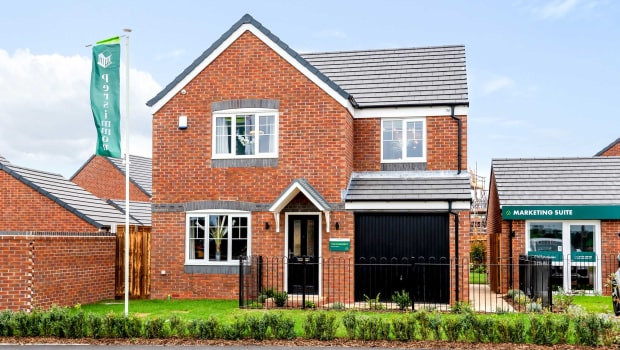
Source: Sharecast
In the year to the end of December 2025, underlying operating profit rose 17% to £472.1m, while underlying pre-tax profit was 13% higher at £445.6m. Completions grew 12% to 11,905 and the new home average sales price ticked up 4% to £278,203.
Total group revenue rose 17% to £3.75bn.
Assuming the Iran conflict and its impact are short, the housebuilder expects to deliver between 12,000 and 12,500 completions in the year, with underlying operating profit towards the upper end of current consensus expectations for between £486m and £517m.
Persimmon said its investment for growth at this point in the cycle will result in increased finance costs and therefore underlying pre-tax profit is expected to be in line with current consensus of £470m.
Chief executive Dean Finch said the company had delivered a "strong" performance.
"This reflects our sustained investment in the business and our commitment to self-help, enabling us to grow in a challenging market," he said.
"Sales in the opening weeks of the year have been strong and the build to rent market is recovering from the slowdown around November's Budget. Whilst we have good visibility of both our costs for 2026 and our demand from registered providers and BTR, the impact of the Iran conflict on customer sentiment remains to be seen. Assuming the conflict with Iran and its impact is short, Persimmon is set to grow again in 2026."
At 1220 GMT, the shares were up 6.3% at 1,300.50p.
Russ Mould, investment director at AJ Bell, said: "Chiming with an improved market mood, Persimmon’s full-year results have given shareholders reasons to celebrate.
"A double-digit increase in profit is a solid outcome given the backdrop and investors will be encouraged to see average selling prices, completions and margins all tick higher.
"This is a better outcome than several of Persimmon’s peer group, and the start to 2026 has been encouraging with sales rates accelerating strongly since the beginning of the year.
"A slight pall is cast over the numbers and outlook by events in the Middle East. At this point it is hard to quantify what the impact might be, but one thing is certain, it won’t be a positive one.
"Build costs are likely to go up, even if only temporarily, and wider inflationary pressures have likely pushed the interest rate cuts craved by housebuilders off the agenda for now.
"Persimmon makes much of the self-help measures which laid the foundations for last year’s robust performance. With little aid coming from outside, it will need plenty of the same to help sustain the business in the months ahead."